
Stomach
Process of Swallowing a Gel
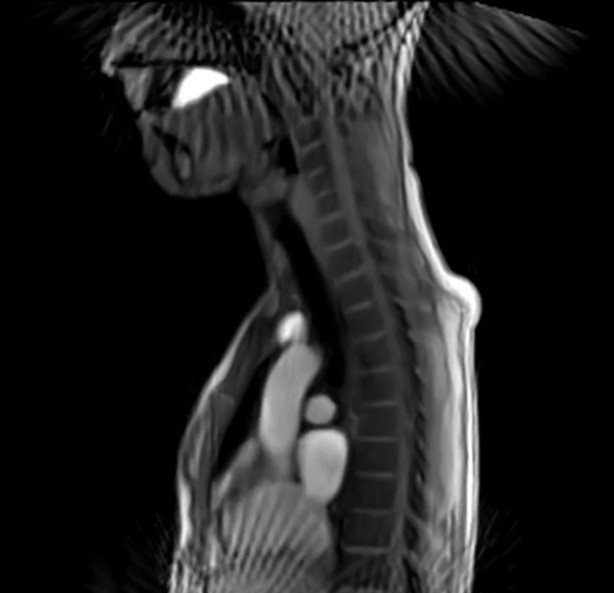
Visualization of the process of swallowing and esophageal transit. T1-weighted, real-time MRI (FLASH2) video of the upper body and head in a lying position. The subject ingests a manganese-labelled viscous gel via a tube. The gel is first positioned in the mouth to initiate the swallowing process. After swallowing, it is transported through the esophagus. Due to the subject's lying position, the gel remains in the esophagus for a short time, right behind the beating heart, before finally being emptied into the stomach. Großmann et al.
Process of Swallowing a Capsule
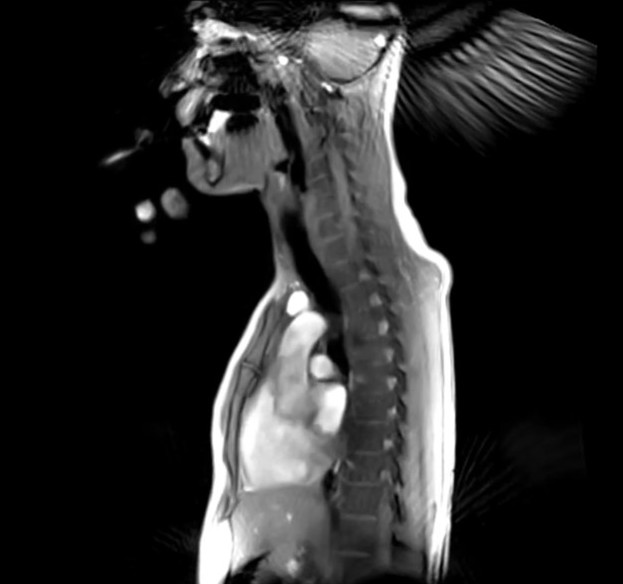
Visualization of the process of swallowing and esophageal transit of a capsule. T1-weighted, real-time MRI (FLASH2) video of the upper body and head in a lying position. The subject ingests an iron oxide-labelled capsule (dark) with a manganese-labelled viscous gel (bright) via a tube. The capsule is positioned in the mouth and swallowed with the help of the gel. After swallowing, the capsule is transported through the esophagus and remains for some time in front of the upper stomach (cardia), at the esophageal sphincter. After a few more sips of gel, the capsule finally enters the stomach and disappears from the image. Großmann et al.
Stomach Motility
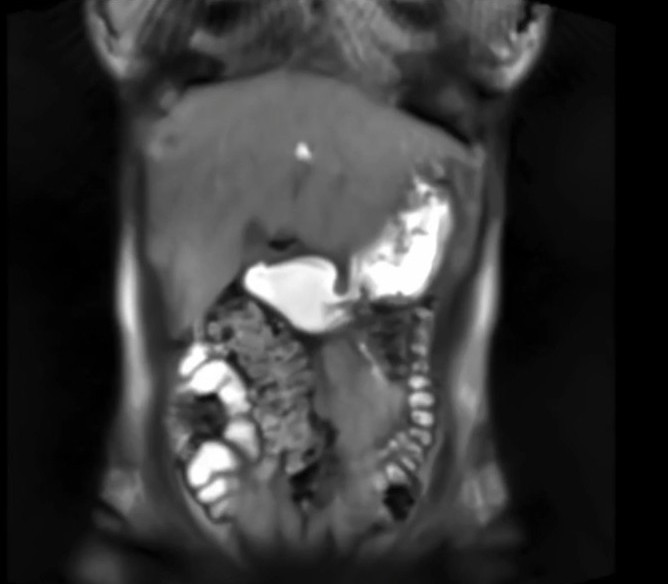
Visualization of gastric motility. T1-weighted, real-time MRI (FLASH2) video of the abdomen in a lying position. The subject ingested 240 mL of manganese-labelled water (bright). The stomach actively pumps and mixes its contents in the antrum, which is located in front of the pyloric sphincter. Portions of the manganese-labelled water that have been emptied can be seen moving through the small intestine. Due to the partially closed pyloric sphincter, not all of the water is emptied immediately, but is thrown back into the stomach's lumen. This can be seen in the MRI sequence due to moving artifacts. Großmann et al.
Stomach Motility - Capsule
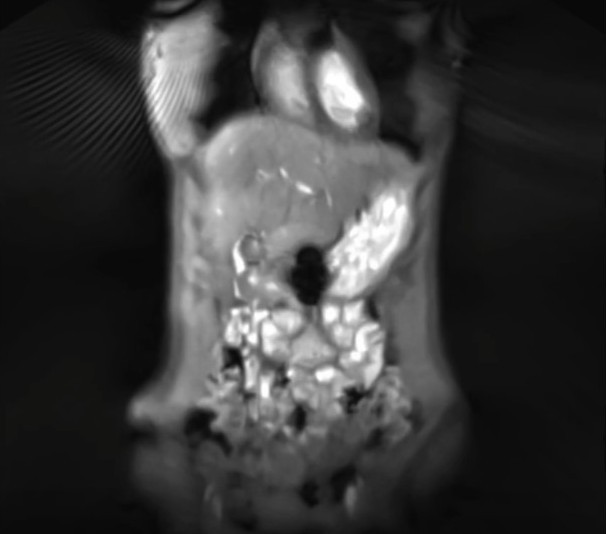
Visualization of gastric motility affecting an enteric-coated capsule. T1-weighted, real-time MRI (FLASH2) video of the abdomen in a lying position. The subject ingested a manganese-labelled scrambled egg meal (bright) and an iron oxide-labelled enteric-coated capsule (dark). The capsule is positioned in the antrum and moves constantly due to gastric motility. When located directly in front of the pylorus, the capsule is not emptied into the small intestine, but is instead pushed back into the stomach lumen by the filtering action of the pylorus and an approaching peristaltic wave. It is highly likely that this capsule will only be emptied from the stomach once all other food content has been ground down and emptied. In the fasted state, a housekeeping wave then pushes all indigestible solids out of the stomach. Großmann et al.
Visualization of the Magenstrasse
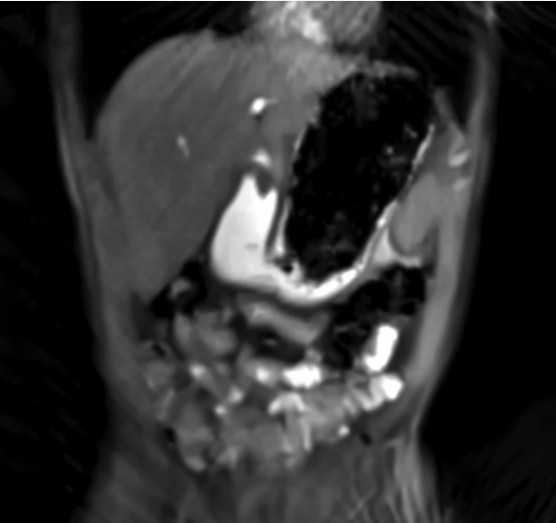
Visualization of the Magenstrasse. T1-weighted real-time MRI (FLASH2) video of the abdomen after intake of an iron oxide-labelled scrambled eggs meal (dark) and manganese-labelled water (bright). The bright watery fluid moves along the stomach wall and in-between the food chunks to be emptied fast from the stomach. The motility of the stomach moves, mixes, grinds and propels the gastric content, while the small intestine constantly moves the emptied chyme. Großmann et al.
Postprandial Motility
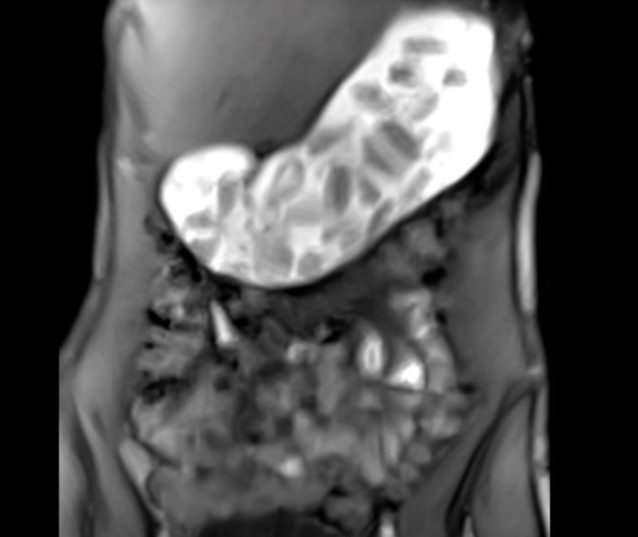
Visualization of postprandial motility. T1-weighted real-time MRI (FLASH2) video of the abdomen after intake of a meal containing gnocchi and manganese-labelled water (bright). Food chunks of the meal are clearly visible and surrounded by the labelled water. The motility of the stomach moves, mixes, grinds and propels the gastric content, while the small intestine constantly moves the emptied chyme and liquid. Großmann et al.
Colon
Colon Mass Movement
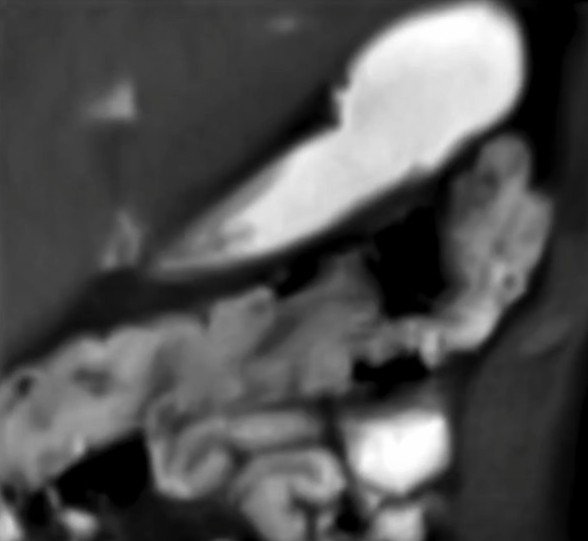
Visualization of mass movement in the transversal colon. T1-weighted, real-time MRI (FLASH2) video of the abdomen in a lying position. After the subject had eaten, we captured a mass movement in the transverse colon by chance. This is a strong, long-distance wave of smooth muscle contraction that quickly propels waste material through the large intestine towards the rectum. This happens several times a day, often right after eating. Eating triggers the gastro-colic reflex, which often initiates the movement. In this video, two such events were captured: one in the first minute and the other in the third. Großmann et al.